Neshum
Neshum, the trade-city of Eastern Osskil, is the first landfall Ged makes after a bitter ten-day voyage from Orrimy on Hosk. It is a low coast lashed by rainy wind, a grey town crouching behind long stone breakwaters that make its harbor. Behind the town lie treeless hills under a snow-darkened sky. Ged has come far from the sunlight of the Inmost Sea, and the city's aspect is as forbidding as the journey that brought him there.
Arrival and the Osskilian Ship
Ged reaches Neshum as an oarsman aboard a sixty-oar longship, a gaunt vessel with a high bent prow carved and inlaid with disks of loto-shell, its oarport-covers painted red and marked with the rune Sifl in black. The ship's crew is a dour company: half are bondsmen forced to work, and the officers are harsh slavemasters who never lay whips on a paid oarsman but create an atmosphere of suspicion and silence. The Osskilian freemen speak a dialect of their own, not the Hardic tongue of the Archipelago, and they are pale-skinned men with black drooping mustaches and lank hair. They call Ged "Kelub, the red one," and show him no regard, only a cautious spitefulness. When the longshoremen of the Sea-Guild of Neshum come aboard to unload the cargo—gold, silver, jewelry, fine silks, and Southern tapestries—the freemen are dismissed, and Ged is left alone in a strange land.
The Journey into the Moors
Knowing neither the language nor the way, Ged must ask for guidance. The man Skiorh, who had jeered at him during the voyage, overhears and says he is going the same road—toward the Court of the Terrenon on the Keksemt Moors. Ged follows him reluctantly, pulling his hood up against the cold, his otak hiding in his pocket. They walk in silence through the streets of Neshum and upward into snowy hills that stretch into bleak rolling moorlands as far as the eye can see. Their road is only a scar through the waste of thin snow and leafless bushes. The chimney-smoke of Neshum is soon hidden behind the hills, and there is no sign of any way. The wind blows always from the east. After several hours Ged sees a tiny scratch against the sky in the northwest, like a white tooth—the tower of the Court of the Terrenon.
The Gebbeth's Attack
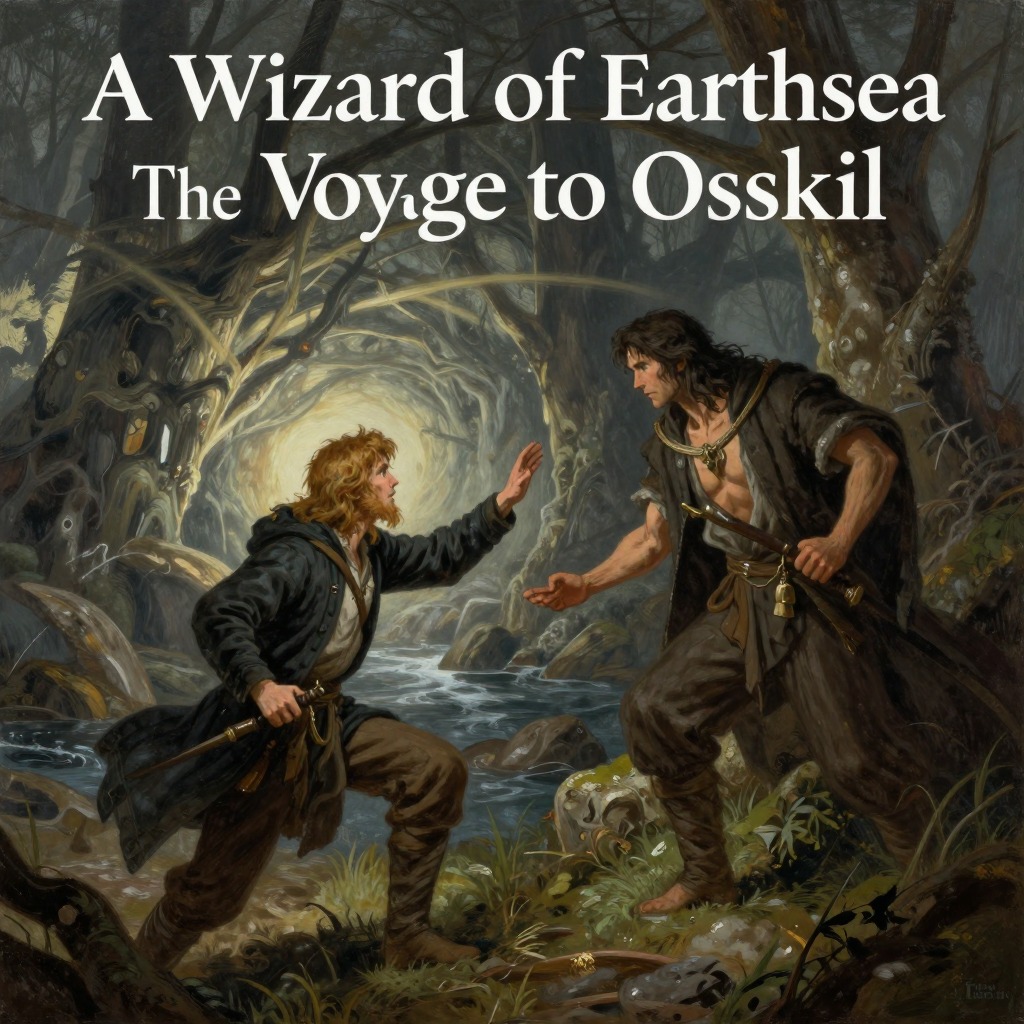
As they walk, Ged grows drowsy with the steady pace and the long weariness of hard days and nights on the ship. The otak stirs in his pocket, and a vague fear wakes in his mind. He forces himself to speak, asking how far they have to go. Skiorh answers without turning, but his voice sounds not like a man's voice but like a beast, hoarse and lipless, that tries to speak. When Ged stops and calls out, the other halts and turns: there is no face under the peaked hood. The gebbeth—the thing that has devoured Skiorh's mind and possessed his flesh—speaks Ged's true name, locking him in his true being so he can work no transformation. Ged strikes at it with his yew-wood staff, but the staff blazes and smolders, burning his hand. He drops it and runs, the gebbeth following a pace behind him, unable to outrun him yet never dropping behind. Night thickens, snow blows fine across the path, and Ged stumbles and staggers ahead until he sees a light before him and hears a voice calling, "Come! Come!" He plunges through a faint-shining gate and falls, caught even as he falls, his mind sliding into the dark.
Narrative Significance
Neshum functions as the threshold between the relative safety of the Archipelago and the perilous, alien territory of Osskil. It is the last outpost of the known world before Ged enters the domain of the Old Powers, and it is here that the shadow, having taken possession of Skiorh, makes its most direct attempt to seize Ged's body and soul. The city's grim, mercantile character—its slave-driven economy, its harsh climate, its isolation—foreshadows the cold, treacherous nature of the Court of the Terrenon and the moral desolation Ged will face there.